Translate

Showing posts with label Psychology. Show all posts

29 March, 2015

To Make A Better World - Excerpt #5

I hope that you will enjoy this and the other excerpts from my book -- To Make A Better World, and share this link with your friends. Leave your opinions in the comments, and if you like please share, thanks.

Copyright, 2015, Joshua Michail, all rights reserved.
Image is copyright, 2015 by Joshua Michail.
FROM: To Make A Better World; The handbook for good secular living in the modern era.
By Joshua Michail

Excerpt #5, from the chapter: "Happiness and Stillness".


(NOTE: ellipses indicate skipped content. This chapter is broken up into several sections.)

2.2 - Love.

It should be well known that there are a few types of love. But, there is also lust, which many people confuse for love. This is the physical desire of another person. At the most basic level love is really a chemical reaction, a process of neurotransmitters firing. But then, that is true of other emotions as well. Romantic love is the most over-rated but also the most enjoyed and enjoyable kind of love. Familial love is the most useful and the most long lasting kind. Familial being the kind of love brothers and sisters feel for each other, or parents and their children feel for each other. It's the love that one experiences in one's family. Familial love is much like the love of friendship, though perhaps stronger. Friendly love is also quite useful, though can for some people in some cases be confused with romantic love, or even lust. The fundamental thing about love is that it is in whatever form, a bonding with another. This emotion, love, is natural and we evolved the trait for the purpose of perpetuating our social nature. Love is a beautiful thing, in and of itself. Though, like all other emotions, it can be exploited by those who are manipulative, destructive, and selfish.
The purpose of love is bonding. Fundamentally, familial love and romantic love are evolved traits in our species. The love we feel often can be quite potent. The love one feels for family is usually strong, and for most as a parent the love for one's child is nearly unbreakable. The bonding of family and friends together has allowed us to survive. As a social species, if we did not feel a strong emotional motivation to help others we would be more vulnerable. This sort of love has allowed so many people to survive at least long enough to breed, and so perpetuate the species. Romantic love is a force to bond people together. Historically, it drives two people together, and to remain together, which improves the chances of survival for their children. In the case of familial love, families and friends are bonded to support each other, which also helps in each individual's survival.
The danger of not applying rational thought to one's emotions cannot be understated. While most often fallacies of appeal to emotion manipulate a person by exploiting one's fear, it's also possible to exploit love. When one begins to feel romantic love for another, that person may find it easier to do things he or she would otherwise, normally, refuse. Some people willingly exploit that to their own unfair advantage. One should always be as vigilant as possible about scrutinizing one's emotions. Some other times a person can become obsessive and behave unacceptably. Some might stalk their victim, whom they believe they love, and someone who might otherwise be a normal honorable person might become a danger and lose his or her honor in the process. In some cases one might be blinded to the abuse of one's love by the person whom he or she desires, and thus suffer at the hands of that person. For most people, though, the main issue lies in trying to determine whether the person he or she desires is actually a good choice to commit to being with. In all of these cases there is a distinct advantage to thinking critically about how one feels and whom one desires. It's quite good advice to take one's self out of the emotional fog long enough to evaluate the case and to make a rational decision.

2.3 - Charisma.

Many people feel that they can't seem to make friends. Or may have difficulties in appealing to people they find attractive. I can't give an all-encompassing, detailed step-by-step instruction guide. And, really there isn't such a thing. But, there are some basic principles that can be very helpful. Charisma is the charm or non-physical attractiveness, a certain appeal. The usefulness of improving one's charisma in helping one attain happiness is that it can help one to make and keep friends, and to be liked by people in general. Having friends, and being liked in a basic sense, has a psychological effect on us. And that effect is conducive toward our general happiness.
There are many times in our lives when we need others to help us. Sometimes we need someone to do something, and we must approach the person about that. The point here is how ought you do that? There are any number of ways someone will communicate their will, needs or request. But, it is important to understand that how one communicates is as vital as what one communicates. As with anything else, it helps you to understand what others are thinking, or feeling, and how they think, what their views are generally. In any event, one can say the old adage “you can catch more flies with honey than with vinegar” is true. Even if you have authority to back up a demand, you're almost always better off asking nicely, or respectfully instructing. Essentially, people are more likely to help, or less resistant to helping, when you are a generally likable person.
So how does one improve one's charisma? Well, first one must understand that physical attractiveness does have an impact on one's charisma. But, luckily, it's not the only thing. Being attractive will naturally give one an advantage, however, sometimes some people rely too much on their beauty and not enough of their social and personal skills. When that is the case, even the most beautiful can be disliked, even intensely. With charisma someone who is typically considered by many to be not very attractive can be more likable than even a typically very attractive person. There are several areas one can work on to make one's self more charismatic. Attitudes, helpfulness, confidence, intelligence, humor, integrity and honor, as well as having good manners, can all be projects to work on and thus improve one's charisma. There are also many people with a natural charisma, but even they can find usefulness in working on those areas of personality.
Manners are undeniably important to controlling whether people think poorly or highly of you. Don't be too talkative. Follow the conversation to avoid straying too much. Allow others to talk and avoid interrupting people. Don't be rude or too ready to be dismissive. Don't talk down at people. Don't presume people are dumb and need every little detail explained. It's better to ask if they know something than to treat them as if they couldn't or don't understand. Don't be overbearing or try to dominate others. Don't try to be intimidating. Rather work on being easily disarming. Address men as “sir” and women as “ma'am”, when you need to show some respect, but usually only early in conversation. Also don't forget to say “please” when you ask for something, and always say “thank you” when anyone does something for you, or gives you anything. I'm sure most people already understand that it's best to say “please” and “thank you”, but the point is that doing so will help improve what people think of you.
Integrity means sticking to your promises, and being consistent. Honor is your standing among most people who don't know you closely. It's a part of your reputation, as much as integrity is too. People naturally prefer to associate with people who have good reputations. If you're generally considered to be honorable, and to keep your promises, and to be consistent, then you're likely considered trustworthy. And if you're trustworthy, people feel more comfortable around you. Reputation is something that one should consider extremely important. Honor is what people know about whether you are moral or immoral person. At the base of the issue, one's honor is a measure of if one is known to in some manner harm others, or help them. Whether people like you can depend, in many cases, on what someone who knows you can say about you. Of course, people can lie, for whatever reason they may have, and to deal with that one should avoid having anything to do with someone one knows to be a liar, or a manipulative or disreputable person. This not only insulates you against their fouled reports of you, but also by distancing your relations with such a person you can better defend your reputation. So, integrity is a valuable reputation, which includes being dependable, being honest, being consistent, being honorable and being principled and disciplined. When people know where they stand with you, when people know what your values are, and that you standards, they will view you more favorably than someone with whom they never know these things. Often when meeting new people their impressions can be shaped greatly by what others have to say about you. So, it matters what the people you know think of you. Reputation is a commodity, in a sense.
How you carry yourself, effects your charm. Make eye contact, but avoid starring. The two-count rule helps, mentally, count out one-one thousand, two-one thousand from when you start eye contact to when you disengage eye contact. Don't stand, walk or sit with a slouch or hunched over. It appears to others as if you're lazy, or afraid. Posture is often interpreted as clues to one's psychological state, even if it's not consciously considered. Our species, as well as many others, naturally intuitively read others by their body language. Obviously body odor puts many people off. It's something that is generally considered unpleasant to encounter. So, bathing regularly will, in this way, help people like you better. Having groomed hair, and nails, present an appearance of caring about yourself. It stands to reason that if one seems to not care about one's self, others will likely not care either. One should remove the excess wax from one's ears, because as it applies to what people think of you it's generally considered somewhat gross. Cleaned out ear wax also displays a sense of caring about one's self. Additionally, brushing one's teeth and using mouthwash regularly controls foul breath which is, again, quite unpleasant to most people.


© 2015, Joshua Michail, all rights reserved.
Facebook.com/JoshuaMichail       joshuamichail.blogspot.com       Twitter.com/JoshuaMichail

17 March, 2015

To Make A Better World - Excerpt #4


Here is yet another sneak peek at my new book -- To Make A Better World, which will be published soon. I hope you enjoy this, the fourth excerpt teaser. This chapter, though brief, deals with the ideas and desires nearly everyone has in finding meaning in their lives. Because the chapter is short the excerpt is also short, after-all, I'm not giving my book away. Please feel free to share this link with your friends, and let me know any thoughts you have, thanks.

FROM: To Make A Better World; The handbook for good secular living in the modern era.
by Joshua Michail 

Excerpt #4, from: the chapter "Living in a Meaningful Way".


We who refuse to accept an imagined afterlife can actually find some comfort nonetheless. One must accept that one's death is inevitable and so that fact should not be allowed to be a source of anxiety. I have long said “there is no reason to worry, if you can do something about it, then do it. And if there's nothing you can do, then don't waste your time worrying!” The fact that we die is immutable, and so the only questions of worth pertaining to our death are how, what, when, where and why. One's life and how much use one made of it is all that really matters in this regard. Did one take the time to enjoy being alive? What did one do with his/her life? Did one make the most of being alive? Did one enrich in some manner the lives of others?
Many religious people ask how does an atheist find meaning in life. The answer is actually quite simple. It is in all the ways any human finds meaning, except, of course, worship of and devotion to the alleged supernatural. We find meaning in our relationships with our families and friends. We find meaning in scientific and philosophical pursuit of knowledge. We also find meaning in helping others, in doing what we can for the greater good of society and humanity, or at least in making a beneficent impact on some people. We may find some comfort in understanding that our life, while of limited time, is an extremely complex expression of the materials of the universe. We are stardust, as it were. All of the organic compounds, in our bodies and elsewhere, are based on carbon, hydrogen, oxygen and many other chemical elements which were created in the stars in the course of their lives. The stars are our creators in a sense, though not intentionally. When the many stars that once existed had died out in explosions the materials that we – and everything we know of – are made of were expelled. This process seeded the universe with rich complex elements. The very elements necessary for life to arise. We are the product of a great universal recycling program.
Yet people still desire some form of ritual, it comforts them. This is an aspect that religions have long offered. It has been one among a few key principles that has really been the glue that has stuck people to religion as believers. In this manner, I think that there are similar secular opportunities. I've heard the tired arguments about comfort in times of pain and loss and about the meaning of one's life, or “purpose”, and on and on in this vein. It is my opinion that these questions can be answered very well by philosophy without the need to invoke supernaturalism. So in response to the tired and sarcastic rhetoric about “Do atheists cry at funerals?”, the answer is yes, of course, after all we are human! But what would an atheist funeral look like then? This is an honest, albeit a naive query. I think that there is a powerful need that we naturally seek at such a time. An atheist's funeral may well include listening to some of the deceased person's favorite music, it would likely include eulogies given by friends and family, a review of the person's life, perhaps even the reading of some of the deceased person's favorite relevant quotations or poetry. A wake is a good possibility, after all wouldn't one want one's friends and family to celebrate, not one's death but one's life? I quite like the thought of my friends and family bonding over reminiscence of their memories of me, and in the process they can help each other in their grief. Wakes are not an ordinary party, they are a tribute to the one who is deceased. In what way does this seem to be so strange compared to a religious funeral?
The point is that all of those things often happen at funerals anyway, but they never need to invoke the supernatural, myths or consolation prizes. All that is needed is the fulfillment of the human need to say goodbye. In that way the need for ritual, or better yet tradition, is obviously fulfilled. Personally, when it comes time for my funeral I would like those who will gather to listen to some of my favorite music, to give an honest yet respectful account of my life and to read some nice relevant quotes. Two of the particular quotes I will share with you here. First, is from Mark Twain: “I do not fear death. I had been dead for billions and billions of years before I was born, and had not suffered the slightest inconvenience from it.” The second is from Richard Dawkins: “We are going to die, and that makes us the lucky ones. Most people are never going to die because they're never going to be born. The potential people who could have been here in my place, but who will, in fact, never see the light of day outnumber the sand grains of the Sahara. Certainly those unborn ghosts include greater poets than Keats, scientists greater than Newton. We know this because the set of possible people allowed by our DNA so massively outnumbers the set of actual people. In the teeth of these stupefying odds it is you and I, in our ordinariness, that are here. We privileged few who won the lottery of birth, against all odds, how dare we whine at our inevitable return to that prior state from which the vast majority have never stirred!”
 
© 2015, Joshua Michail, all rights reserved.

21 November, 2014

Please Help Me! Here's Your Chance To Help Me Decide On A Title For My Book.

I'm now trying to settle on a title for my book. I would like some input. So, here are the candidates. Please vote for the one you think is the best. You can comment below with your choice and anything you'd like to say. I'd really appreciate some participation in this poll. Thank you.

For reference, the book is a sort of handbook, self-help book, in which I try to offer a secular alternative to the rules and form of religions. The idea in this book is that in the first of the three sections, I discuss society, evolution, humanity, government and economics, philosophy and psychology. I do this to layout some basic concepts and establish a basis for the rest of the book's discussions. The second section I discuss morality, secularity, honor, and ways to look at living life in a way that we find meaning, without any religious context. In the third section I discuss a variety of things that people often wish to improve in themselves, and how these areas can be accomplished without religious context. Often self-help books talk in a religious-mystical context, but I wanted to help people but with a secular option.

1. A Moral New World (the current working title)
2. Your World Within
3. Being In the World
4. The World and Us
5. Life and You
6. Making A Better World
7. Lifelong
8. Your Life
9. A New View To Your World

29 September, 2014

Conspiracy; The Nature of Beliefs & What They Have to do with Honor.

The terrorist attacks on September 11th, 2001 is one of
the most controversial and heated subjects of all
conspiracy stories.
I am going to tell you that the beliefs you hold can affect your honor. I know this may seem odd, but I will explain my position. However, I want to also delve into some other issues regarding beliefs, most specifically on conspiracy “theories”. Recently, a friend of mine shared a link to a video lecture by Rob Brotherton, an Irish psychologist. The title of the lecture is Psychology of Conspiracy Theories [linked], which happens to also be his doctoral thesis. I found the lecture to be quite interesting, and it got me to thinking on the issue, and beyond. It raised a few issues for me that I want to deal with here. One being the problem I take with calling conspiracy stories “theories”, and I believe you can start already to see where I'm going on that point. Another point is about beliefs based on emotional thinking versus beliefs based on evidence.

There is no such thing as a “conspiracy theory”. I know this is a bold statement, but soon you'll see my point. There certainly are people who believe that there are secret plots, by a few allegedly extraordinarily-powerful interests, to take control of the world. And, it's true that sometimes conspiracies occur. Though, you'll never find the truth on sites like Info Wars, or Conspiracy Watch, and from people like Alex Jones and David Icke. In fact, there are some red flags sources like those raise, and alarm bells they sound. For instance, as a general rule, one should be quite suspicious of anyone who insists, without being questioned first, that they are telling you the truth, or that they have a secret that no other has. One should be, rightly, ready to dismiss those who make such ridiculous claims as the conspiracists do. For instance, if it's a secret that some extremely powerful cabal of conspirators would kill to keep silent, then why is the person revealing the secret on media outlets, such as You Tube, or Facebook, spreading these “secrets” for so long with no interference? Why would such secret cabals do what they are being accused of doing, what do they really gain? Why can't they use more reasonable approaches? Why is it taking them so long to accomplish their goals? If they're so powerful and secretive, why is this secret even being talked about by anyone? You get the idea, the list of questions about the story tellers goes on for a long time.

The point, however, about the term “theory” that raises my ire, is that it's not acceptable to use that term for such nonsense. The term “theory” is specifically scientific, and so should be limited to that use. The definition of which is this, Theory (n.): A stated set of ideas that; 1. coherently, 2. explain observed phenomenon, 3. and which is derived from a hypothesis that has been tested repeatedly by different groups who all found the same results. I make this point because there are two main ways people with questionable agendas tend to misuse the word. First, the conspiracy story tellers, who want people to believe there is more veracity to their claims than really exists. After-all, “theory” sounds much more important and intellectual than “story” or “opinion”. The second way that it is misused for a particular agenda is among creationists, who actually use the term in another way. They like to say “theory” as if it means the same thing as “opinion” or “just a guess”. They use the word for such actual scientific theories as Evolution by Natural Selection in the context of their discussion in the hopes that they can discredit the veracity of such science. The common acceptance of people using the term in both ways actually harms the public understanding of science. I suggest, strongly, that everyone starts to call people out on this problem. We owe it to humanity to demand intellectual honesty. We must correct our friends on the misuse of the word “theory”, and this is why I say there is no such thing as a “conspiracy theory”.


To help facilitate this effort, I suggest a few terms that can be used to replace “conspiracy theory” and “conspiracy theorist”. So, one who proposes, endorses, or spreads conspiracy stories is a “conspiracist”. This term should not be confused with “conspirator”, which is one who conspires to commit whatever the story alleges. For instance, in Jenny McCarthy's endorsement of the false story that vaccines cause autism she, by extension, endorses also the claim that governments and doctors are conspirators attempting to keep their “conspiracy” a secret. In this sense Jenny McCarthy is a conspiracist, because she is spreading the conspiracy story that vaccines allegedly cause autism. It should be noted, by the way, that the original article making the claim was scientifically discredited and the publisher retracted the article, though the doctor who initially made the claim sticks to it, even after his medical license was revoked. Further, “conspiracism” is the term I use to describe the attitude or belief that conspiracy stories have some legitimate footing for consideration and deserve to be taken seriously. More specifically, I'd say conspiracism is an undue and excessive willingness to believe, or accept as plausible, such conspiracy stories.

In the lecture that inspired me to write this essay, Rob Brotherton discussed the psychology of conspiracy stories. I find psychology to be an astoundingly interesting subject, but I'll try to keep this discussion short since we all have busy lives. Among the particular issues discussed in the lecture were the personality traits of people who believe conspiracy stories. Some research has been done which indicates the possibility that people who believe one conspiracy story also tend to believe many other conspiracy stories. Additionally, there tends to be a sense of powerlessness in the world on the part of the person who believes such stories. The typical conspiracy story narrative is a perception that some evil and extraordinarily-powerful group is responsible for the bad things that happen in the world. Rob Brotherton defines conspiracy “theories” as: (1) “an unsubstantiated allegation of conspiracy (2) pertaining to events of profound importance, (3) competing with a more plausible explanation (4) which assumes deception and misinformation [from the alleged conspirators], and (5) presumes malicious intent and hyper-competence, and (6) insulates the idea against correction”.


Moreover, there are some distinctive personality traits that are often quite evident. For one thing, most people who believe such conspiracy stories tend to be extraordinarily open to unusual ideas and are more willing to accept the stories that seem compelling to them. Additionally, believers of conspiracy stories tend to be mildly, or more, paranoid than most. They also tend to have quite a bit of bias. There's Projection Bias, in which a person presumes that most others think and behave like he/she does. Michael Shermer calls another bias “Patternicity”, which is an ability that most people have to see meaning in random stimuli. Though for the religious and many conspiracists this trait is more noticeable and usually not considered by the person who believes such things. A very common bias among conspiracists is Proportionality, they often believe that major events must have major players, such as the John F Kennedy assassination. Conspiracists often insist that because Kennedy was an important man the assassin must have been involved in a conspiracy that must have been far bigger than a lone mentally disturbed gunman. But, perhaps the most powerful and intractable bias is Confirmation Bias. People who believe in conspiracy stories usually ignore and reject evidence that does not support their existing beliefs but willingly and quickly accept anything they can perceive as supporting their presumptions.

One more very interesting point that I want to discuss is the difference between emotionally based beliefs and evidence based beliefs. Mr. Brotherton also raised this issue in the video lecture. And, as promised, here is where I'll begin discussing how one's beliefs can affect one's honor. Now, for Mr. Brotherton's sake I will state that he never mentioned honor. Rather, he talked about how in debating with someone evidence-based arguments will not be effective if that person formed his/her belief through emotions. You see, there are two basic ways people form opinions, or beliefs. One is through being presented evidence and logical arguments. The other is through appeals to emotions. Obviously the problem with emotionally-based beliefs is that they are not formed through critical examination of evidence. So emotionally-based opinions or beliefs tend, all too often, to not reflect anything resembling reality. Fundamentally there can be no honor in holding beliefs that are wishful thinking, that are discordant with reality.

But, worse still, some beliefs can be actually quite dishonorable. In fact, when one holds a belief that can motivate one to do harm, or to advocate others to do harm to themselves. And since there is no honor in ignorance, one cannot expect that being ignorant of the facts can excuse the dishonor one does to one's self by such dangerous beliefs. Such examples, sadly, exist. When someone like Jenny McCarthy tells parents to not vaccinate their children, she is actively giving medical advice. The problem in this sense is that she is nothing like a qualified doctor. This is a highly dishonorable thing to do. In fact, I will tell you this is the fundamental reason I say Jenny McCarthy is without honor. She has chosen to accept the already discredited claims against vaccinations, and she lends her cheapened celebrity status to support a most ridiculous conspiracy story. Her activism against vaccinations is, in plain fact, actively encouraging parents to harm their children. And, for this, there is no excuse. She has thrown away whatever degree of honor she might have had by holding fast to her beloved conspiracy fantasy.


Copyright © 2014, Joshua Michail
All Rights Reserved.

30 November, 2012

Today is Samuel Clemens' birthday. Mark Twain as he was commonly known was an American author, humorist, intellectual and humanist.


03 November, 2012

Religion, What Is It Good For?

What if I told you there was something good about religion? You might ask, “is it the sense of community one gets from belonging to a church?” Or, “is it the moral code?” Perhaps, you might be wondering, “it's the transcendence people feel, right?” Well, not exactly. I know that some of you might be thinking I've lost my mind. And some who are reading this might think I'm somehow a religious person. You need to read on. The fact is that there is something valuable to us that religions have to offer. Each of those points are actually products of the singular thing of value, about which I'm teasing you. Okay, so what it all boils down to is the worldview. Every religion offers a worldview. But, I think we can be very well served by having a worldview as well. I know, I know. What am I thinking? “Religions have something good about them?” Are you seriously saying this? Well, let me explain.


Religions are bad. They are the root of most – though honestly, not all – evil. Whenever someone claims that religions do some good, they are trying to justify having religions but the fact is that any good that religions do is far outweighed by the harm they also do. Indeed religious worldviews are seriously dangerous and hurtful to all of humanity, let alone the world. And it's not a particular religion's worldview which I think is good. Quite the contrary, actually. It's the idea of a worldview, the idea of having a philosophical model by which we live our lives, which I believe to be good.


Obviously religions have a very seriously flawed premise on which each of them has based their worldview. So, it's not that which is good, the premise I mean. The idea that there exists any such thing outside of nature – a supernatural realm, including a heaven or hell, and afterlife –, is completely unsupported. As premises go, assertions that there is a realm of existence – and beings living there, like gods, angels, souls and whatever other fiction – which is not even hinted at by a single shred of evidence is as bad as flawed premises for a worldview gets. There are many types of worldviews, some of which are good or bad. Some worldviews are also more seductive than others. Most worldviews have some method to propagate them, which is built in. In Christianity, for example, the believers are taught that “only through believing in Jesus can people be saved from hell.” It's clearly a contrived scare tactic. They're taught that they ought to missionize for their religion, to go out and tell people about it and try to convince others to join them. In Judaism, though, missionizing wasn't really part of the religion. Instead the idea was to have as many children as possible. Christianity and Islam both ran with that same excessive breeding policy, but each added their own twist as a secondary method to propagate the religion. But, there are other ways to propagate a worldview.


I believe that employing other means of propagation can be far better than the approach the religions generally take. There is a basis, in the religious worldview, for the reasoning behind the breeding competition. They believe that some god created the universe for them. In Christianity, the concept is called “Dominionism”, in which they claim humans have a “god-given right” to dominate the world. But, this view neglects reality. The world can only support so many people. Earth is actually at it's full capacity for humanity. So, in reality, breeding the worldview is not a tenable practice. It is clear that there are so many children born, who are put up for adoption. There is very real and desperate need. Adoption, as a means to propagate a worldview can proverbially 'kill two birds with one stone'. One could be to promote the adoption of children, instead of breeding. By adopting children – likely born of religious people – one can teach the child to be rational, instead of religious. Thereby slightly diminishing the number of people who will have a backward and harmful worldview. Clearly the impact could be great if many rational people took this approach. Additionally, it would increase the number who likely hold a progressive and good worldview. All the while, also being a proactive measure toward curbing the overpopulation of our planet. Another could be to set the example that inspires people to take on the worldview. If your worldview directs you to be charitable, to have a strong work-ethic, to be rational and logical, to be honorable and moral, to pursue the truth scientifically, to be kind and generous, to be intellectually honest, and to always improve yourself, it will be noticeable. It will make you a model, by which others will be inspired. Such a worldview, by your own behavior, would prove itself to be worthwhile having. It should certainly speak for itself, that religious worldviews push people to accept them with threats of eternal suffering and promises of eternal rewards, compared to a worldview that does no such a thing.


By this point you're probably wanting a clarification of just what is a “worldview”. It's fundamentally a uniform way of looking at the world and life. It's a personal outlook on the world. It informs how a person interprets the actions and words of others, and indeed all of the world. There's a reason why it's called that, after-all. A worldview is a philosophical system, or a model. It's a system of values, beliefs and attitudes, by which people live their lives. The reason I'm interested in worldviews is that everyone has one in some form or another, regardless of whether each part of it is intelligibly connected. Fundamentally, every person thinks philosophically to some degree. Granted most people are not particularly active about it. Indeed, the large percent of people are not even aware that they have a worldview, or what that means. Most people tend to think about something in a philosophical manner only once in a while, and then without it dawning on them that it is philosophical. But, when they do they usually derive some principle which guides them. Though, usually, when most people derive that principle it doesn't occur to them how they're doing so. For most people, the idea just comes as a realization or they encounter the idea and like it. Since worldviews are a philosophical product, a serious problem arises when people haven't coherently connected the various parts. But, a worldview addresses many issues, like how it is that we know what we know. That is, in philosophical terms, an epistemological question. Religious answers tend to be that a supposed force outside of nature reveals the information to the individual. Even if one doesn't think about or realize that he/she has a worldview, that philosophy is nonetheless illustrated when one says something like “god has a plan for you”.


Though a worldview can be bad, good or indifferent in many ways, it's still useful. Even a bad worldview gives structure of a sort to one's life. But, obviously I cannot morally argue for holding bad philosophies, and that's what religions offer. The religious worldviews often implicate themselves as immoral when the opinion is that there is another chance to live again. The very idea of a life after death necessarily diminishes the value, the sanctity, of this life. It suggests that suffering is acceptable because those poor victims, whom we've ignored, will be given paradise for eternity. Unless, of course, they happened to not believe in the correct god. The religious view is that ignorance is bliss. The religious view is that religious belief is sacred. The religious view is that morality is seriously concerned with pleasure and desire, our thoughts, our self-agency and some deity's authority, rather than human suffering. At the core of the problem with religious worldviews, inescapably, is the premise that something outside of nature exists, let alone a god. It's an unproven and unprovable, untenable and unsupported claim. And it is that claim which is the basis of all of the rest of the worldview.


I believe a secular option can be developed for non-believers to have the advantage of their own worldview. A philosophical model which is based on science as the foundational premise. I believe that worldviews are useful and beneficial, but not just any will do. A good worldview would have to be concerned with genuine morality, instead of unrealistic and delusional claims of morality. A morality concerned with suffering rather than satisfying the ego of a fictional character. A morality concerned with improving the human condition for all, rather than suppressing mere disagreement. Indeed, such a secular worldview would need to demand that one's beliefs be based on evidence and logic, rather than obedience and wishful thinking.


I have been working on such a secular worldview. I believe a good philosophical model will help people to live meaningful, healthy and happy lives. It must be the purpose of such a worldview that people are not led to confusion, misery and immorality. Religions have done that for thousands of years. It's time that we have a philosophical model that gives us the benefits of the structure and principles, but now based on reality instead of fantasy. While there are other philosophies out there, which non-believers can adopt, they all are limited in their scope. And some are just plainly bad. Take Ayn Rand's so-called “Objectivism”, for example. A philosophy, which is in reality just an attempt at justification for “rational selfishness”, as even Rand, herself, had put her idea. On the other hand, Humanism is a respectable and good Moral Philosophy. But, it doesn't address issues of Epistemology or Metaphysics – the questions of “what is there to know?” and “how do we know what we know?” Solipsism, while a Metaphysical philosophy is rather absurd. Could anyone reasonably respect the idea that all of the universe, including other people, are all in one's head? A figment of one's imagination. While it is Subjectivism, in the extreme, there are some people who favor the Objective view (not to be confused with Ayn Rand's silliness). Though they take their conclusions the other extreme. The idea that how one perceives the world around them is not important. But, it really is ridiculous to make such a suggestion. The reality is that it's true that the universe, and all that is in it, objectively exist and that the facts are as they are, regardless of personal opinion. While, at the same time, to deny the importance of subjective perception in informing how we act is woefully ignorant. After-all, it is only through one's particular individual understanding of the world that one can operate.


Any worldview must encompass all aspects of life and philosophy. Most philosophies, however, fail to cover the multiple fields, or fail to connect intelligently the different philosophies. Honestly, I can't see how one could support a humanist moral philosophy with an exclusively Solipsistic view on what exists and how we know anything. For that matter a Philosophy of the Mind, for Solipsists would be rather simple, in that the mind would be the extent of the universe. That is quite silly, and not much good really. Any coherent, stable, useful and good worldview would necessarily have all the positions on the various issues be able to point back to the premises. The foundation of the life-philosophy should be able to draw from reality and establish axioms that support the upper-level conclusions. So that one can argue from the facts about the world, including biology, to support our own evolutionary history. And that from the evolution of humanity one can argue to support a secular moral view based on the necessities of societies, as part of our species' nature. This, and more, I believe is possible for those of us who do not believe in supernatural claims. In fact, this has been my work for the past several years. I've worked, and am still working, hard on this because I believe that to have such a secular worldview is actually a good thing. A good secular worldview provides the structure for our values, beliefs, attitudes, actions and makes up a significant part of who we are, individually.


Copyright © 2012, Joshua Michail

18 March, 2012

The Popularity Of Religion; On Why People Choose To Identify With A Religion


The fact that religions have, so far, withstood the constant progress of human enlightenment suggests something about the nature of religion itself. The sort of progress that is the advent of scientific understanding, technological improvement and secular humanitarian ethics. Yet, the reason is not what religious people might hope. It's not that the assertions of religions are true, because mostly they are not. The survival of religions, almost amusingly, is because of the evolution of religion. Indeed, the history of the world's religions shows that over time they have changed, adapting to better fit with the current social environment. Of course, this is only on the whole, even if it's a sloppy-fit, and there are some religious sects that hold on to more archaic versions. Religion, as a phenomenon, is opportunistic and exploitative. Religion always seeks to corner the market, to be the only game in town. But, philosophy can compete and even surpass religion. With a philosophy one can find that religion becomes entirely vacuous. In deed, the fact that religion is human-made can be seen when one examines the reasons why people choose to be religious. It would not be possible for any religion to take root, let alone thrive, if their soil, the human mind, were not fertile enough for religiosity.


Interestingly, the reasons you might think a person would join a church or identify with a religion are probably wrong. Or at least, they may be only a few of the many reasons. It's likely that you would say the reasons a person belongs to a church, or religion, are the ones a person would say to explain for him or her self. That is, you might just accept whatever reason a religious person gives for being a member of a religious congregation. I don't deny that there are the common reasons people think of, but I think those commonly cited reasons are only scratching the surface of the issue. I also think that those other possible, lesser-contemplated, reasons are more powerful and yet under-appreciated.


I think, from a sociological & psychological perspective, people deeply desire certain things, which religions offer. Religions survive by ingratiating the given cult authority into the minds of the believers. In addition to a community, religions generally also offer the succor of an afterlife, a sense of significance or purpose, and strong order and rules. While the “eternal paradise” concept may be appealing, it is also not realistic, nor based on evidence. The sense of purpose, i.e.: “god's plan”, is really merely appealing to individual insecurities. People want the stability which comes from having absolutes. But absolutist morality is so inflexible that reality itself becomes unacceptable. And that is the off-putting flavor that religion offers


The power of nature is undeniable. Even in ourselves, we, who are but one of millions of species of life on this planet. Our species evolved as a social animal. We have in our very nature a dependency on each other. This drives each of us toward being a part of a group. Religions, being formed and maintained by people, get this fact. It's all about the sense of belonging, the community, the shared culture and mutual support. Ultimately it can be described as the attraction of the in-group. Religions appeal to this inclination very well. They offer the sense of community membership that everyone wants, and they do it skilfully. But there is more to the popularity of religion than community alone.

 
Religions offer a world view, a way to understand the universe. Religious worldviews are certainly grotesquely flawed, but the fact is they're generally comprehensive views, nonetheless. Of course, when one chooses to believe in myths and superstitions, the unnatural (supernatural) worldview seems to make sense to the believer. It has the added advantage that the worldview is usually already-constructed, making it much easier for people to adopt. They need not think for themselves, which religions discourage anyway. Religious worldviews tend to be not just easy to adopt and grasp, but also uniform. I mean uniform, not in the sense that all the members of the group believe exactly the same things, but rather that the framework is the same. The minor differences are not what the worldview is made of, despite wide variation and at times violent disagreement.


While it's worth noting all of what religions offer, there are only three items that seem to be legitimate issues to address. I believe there are secular alternatives that address those three legitimate issues, the feeling of belonging to a community, the moral compass and the philosophical worldview. I'll save those for discussion later though. But first, I believe that what religions offer, positive attributes, can be categorized into two main groups; one which is vain and useless, and that which is a legitimate topic of concern.


The first category, of what religions offer, is absurd or at least unfounded. People can do, and ought to do, without those pretenses. They are only appealing for those of weak will or ignorance. However good it may feel to believe such selfish nonsense, the fact is that most of it, if not all, can be abandoned altogether or substituted with more reality-based certitudes. In the second category there are some offerings which really speak to human need and the human condition. Yet, the religious construct which is foundational to those offerings are harmful in the long-run, or at least misguided. These issues can't so easily be done without, even when the particular religious model is toxic. To this point, we are fortunate, however, in that there are secular alternative options.


I think that there is another thing which can explain why religions are still so popular. Even in this era of instant widespread information and immense knowledge -- factual & objective knowledge -- on such a never-before-seen scale. This is early indoctrination in one's life of the god meme. The religions have intentionally devised that from the moment of birth a person should be taught to be a part of the religion. In a sense it is the confession on the part of the religious that the ideology they hold, the faith, would not have much of a chance of surviving if it were only allowed to be introduced to adults. It is a calculated exploitation of the natural, evolutionarily beneficial trait of youth, to believe easily what the parents or other trusted adults say is so. It's a credulity that can keep a child from a danger because she was told that a 'boogie-man' will get her. But then, with constant reinforcement the religion becomes sacred unquestionable, yet only supposed, “truth”.


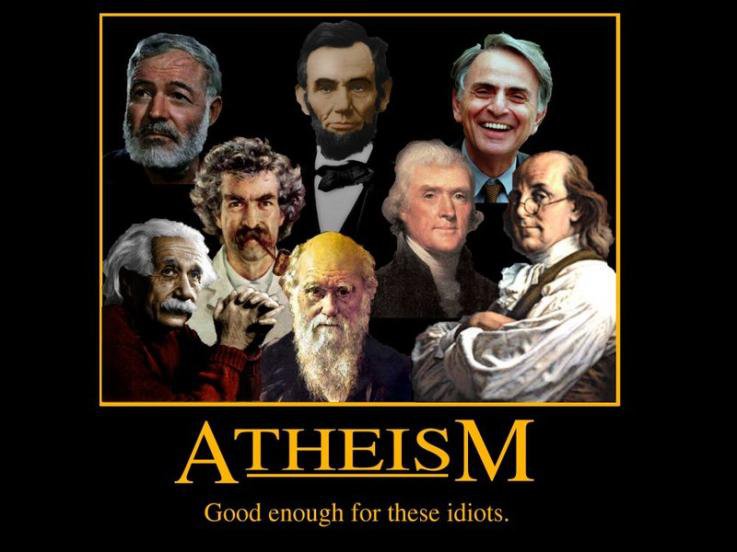
Atheism only offers us the rejection of supernatural nonsense, a rejection of unsupported claims by the way. We throw off the indoctrination and rightfully so. But, there is something that is missing for so many people once that liberation from superstitious dogma has been achieved. There is even for an atheist something impressive or appealing to that, which for so long has been attached to religion, but which can be usefully decoupled from it. Those advantages and pleasures can be offered us, minus the superstitions, the authoritarian dogma and the factually false premises. I propose that we seek the alternative secular worldviews, grounded in objective facts and logic, and to promote them whenever we can. With time and hard, but very worthwhile work, we may be able to replace in large portions, if not entirely, religions. We may develop a better way. We may provide the sense of community and traditions. We may provide the moral compass, one that is concerned with human suffering instead of pleasing an authoritarian dictator. We may offer a worldview that promotes critical thinking and logic over blind obedience and beliefs lacking in evidence.


Copyright © 2012 Joshua Michail

02 March, 2012

Homosexuality; The Problem With Society.


            I have a few gay friends, some of whom are open about their sexuality. And why not? There is nothing to hide, nothing about it of which to be ashamed. Some time ago one of my gay friends confided in me that he had attempted suicide. I've only known him for a few years now and, the whole time that I've known him, he has been open and comfortable with himself. I won't tell you his name, since that is none of your business. But, he told me that his attempt to take his life was a few decades ago, and I seriously doubt he'd consider it now. He's a middle-aged man, I think he was probably a teen or in his 20's when he tried to kill himself. Luckily he didn't succeed at that, but the sad thing is that the pressure-point that caused him to try was the conflict between society and his sexual orientation.


As a heterosexual person I had a difficult time understanding, at first, why it seems that suicide attempts are more common among gay people. But, with some time, having heard, or read, enough stories about it I get it. Even if one is lucky enough to have avoided direct bullying, the pervasive attitude in our society is that homosexuality is "wrong" or "abnormal". I say 'direct bullying' because of the wide-spread social normative, the idea that being other than heterosexual is strange, or queer, or something deserving of disapproval. The constant harassment about being a homosexual would obviously be quite depressing. And depression is one of the most common drivers to suicide. 


            This social normative is not healthy, for neither the individual or the society, and it needs to be corrected already. It's plainly wrong and it is a heinous and shameful idea. Our culture, our society, marginalizes people a little too easily. This deeply ingrained adverse posture of the whole of our culture and society is a de-facto bullying. It's a sort of auto-bullying, a very real and unacceptable oppression.


Heterosexuality is not “normal”. It is merely more commonplace. Of course biological reproduction, in mammals like humans, requires heterosexual intercourse. But, no person chooses whether to be gay or straight. The idea that 'heterosexuality is preferable' is disgraceful primitive bigotry. It wrongly implies that a person's worth is necessarily connected with his or her desire to propagate our species. Yet, clearly with homosexuality being in the minority, and with our exceedingly unnecessary and excessive numbers, pinning a person's value to his/her potential reproduction is ridiculous. There are very dangerous archaic ideologies that underpin this social retardation. This evil thought and the ignorance that is accomplice to it will continue to hold humanity back. And worse, it will continue to be a destructive force.


Among the worst offenders, the proprietors of this filth, of this immoral disregard for life are the Catholic church and the evangelicals. With their broad influence and propaganda they still have such a dangerous power on society as a whole. In deed, they have maintained, to this day, a formidable grip on the reins of social influence. But, it's certainly possible to pry our society and our culture from their poisonous fingers, one by one. We can no longer tolerate the evil. For example, the Pope has willfully spread lies in order to crush innocent, desperate people and enslave them to a life of obedience to his will. The Pope actually instructed the priests and other church officials to tell the people of Africa that condoms increase the risk of getting Human Immunodeficiency Virus (HIV), which causes Acquired Immune Deficiency Syndrome (AIDS). The claim that condoms increase the risk of spreading HIV is a blatant and dangerous lie. The Catholic church went even further in extorting the people. The Pope imposed a requirement for Africans to swear to never use condoms or else they would not receive food and other aid from the church. This is the same church that tells innocent people that because they are homosexual they will burn in hell. The same church that covers up for and protects their priests after they have raped children. And the evangelicals, in America, agree with the Catholics that homosexual people will burn in their made-up “hell”.


But, when society's views change enough and that change becomes more and more normal the churches stop having the power to oppress the people in that society. We can do something about the problem. In this particular case the disgraceful attitude toward innocent people based on the very trivial notion of their sexual orientation. We can make changes in the culture and the society. Eventually the churches will lose their death-grip on our society's throats. The more civilized, the more inclusive and egalitarian a society becomes the healthier and stronger that society becomes. We can be sure that the suicide rate among our young and among homosexual people will drop significantly when our culture shifts to, not just “tolerant”, but a more accepting and respectful normative. To some extent “tolerance” is the rule now, yet, to be honest, tolerance means to grudgingly put up with something. The cultural normative must be changed to not treating people as if homosexuals are equal to heterosexuals, but rather to actually realizing that we both are equals. This change will be slow, because it can only happen one changed mind at a time. But, it is our civic and human duty to make that change happen.


Copyright © 2012 Joshua Michail

18 December, 2011

Perspectives; A Powerful Lesson Of Life.


              Lessons come to each of us in a variety of ways throughout our lives. Some may not realize they are learning a lesson, until later upon reflection. Some people may not even learn the lesson that is there to be learned. Still others learn quite readily. While some just lack the proper perspective to get the most out of the lesson. Perspective can make all the difference. Though this point is often missed or ignored altogether, the issue of perspective and its importance is one life's greatest lessons.


Everyone has a perspective on any given issue. Only the dead have none at all. Yet most people don't consider their own perspective, nor do most care what another person's might be, let alone giving any real thought to the nature of perspective itself. So what is a “perspective” you might be asking? It is a point-of-view, a way of looking at some issue. It is an attitude, or set of beliefs and ideas, about some issue and applied to a given circumstance or situation. In this fashion every person has some form of larger philosophy to which they adhere. In fact, each perspective is a part of, or is influenced or required by, one's philosophy. A perspective is a little bit of philosophy. Though a perspective and a philosophy are not the same thing, they are related and tend to go hand-in-hand.


A perspective can be changed. It is actually possible to change many of one's perspectives without actually changing one's philosophy. Changing one's perspective may not always be such an easy thing to do. But it can become a little easier as one gains experience in it. There can be some good reasons to change a perspective. Depending on the situation or circumstances of a given issue there may be many equally valid or even good perspectives, but there are also likely to be some that are bad or even harmful. A maladaptive perspective is one that can span a range of possible less-than-desirable positions on a given range of subjects. A maladaptive perspective may prevent one from enjoying something that would otherwise be enjoyable, or it may cause a person to needlessly avoid something. It could also lead a person to take a destructive position against something that is not truly deserving of it. But, perhaps worst of all, it could lead one to take a lazy or uncaring, or even protective, position toward some issue that may truly deserve to be destroyed.


One should be concerned about whether one's perspective is maladaptive or not. When one has a maladaptive perspective, one may not be aware of it, but if one is, it's best to change one's perspective. A person should be ready and willing to change his/her point-of-view when it is best to do so. The maladaptive perspective is something that may well permanently vex humanity, but wherever it is found it should be adjusted, corrected or eliminated as needed or warranted. The maladaptive perspective is, after all, unhealthy and unwise.


In a way, a good perspective is seeing the proverbial forest for the trees. While a bad perspective is not seeing the forest for the trees. That is to say that a good point-of-view will have one seeing the aspects of the situation at hand that one might otherwise overlook. Consider, for example, my grandmother wants to fly to a city across the nation, but she dislikes the idea of the extra time it takes now because of the enhanced security at the airports. Instead of focusing on the inconvenience of the extra security, she could also consider the fact that the greater the efforts are to ensure security the safer she may be in her journey. In a point-of-view that ignores the greater safety of extra security measures one only really considers the negative effect. But, in a good perspective one also considers the benefit, the positive effect, of being more safe on that airplane. One may still wish it didn't take as long, but one would likely also be a little more patient and tolerant and understanding.


In deed, one's point-of-view greatly influences how, and to what degree, one's mood is affected by a given situation or circumstance. It comes down to attitude. Pessimists will tend to have negative attitudes, and thus more often negative or even dismal perspectives. And optimists tend to have positive attitudes and therefore more frequently positive, or up-beat perspectives. In either case the extreme ends of the spectrum can have some dangerous or undesirable consequences. There is a middle-ground however. It is a broad middle-ground, full of various positions that one could take on a given issue which may not necessarily contradict a different position on a different issue. Ultimately, the world is indeed what you make of it.


Copyright © 2011 Joshua Michail